Conference paper / 2026
Active Learning for Deep Learning-Based Hemodynamic Parameter Estimation
Statistical Atlases and Computational Models of the Heart (STACOM) · MICCAI 2025 workshop · Published · 2025 conference, 2026 proceedings
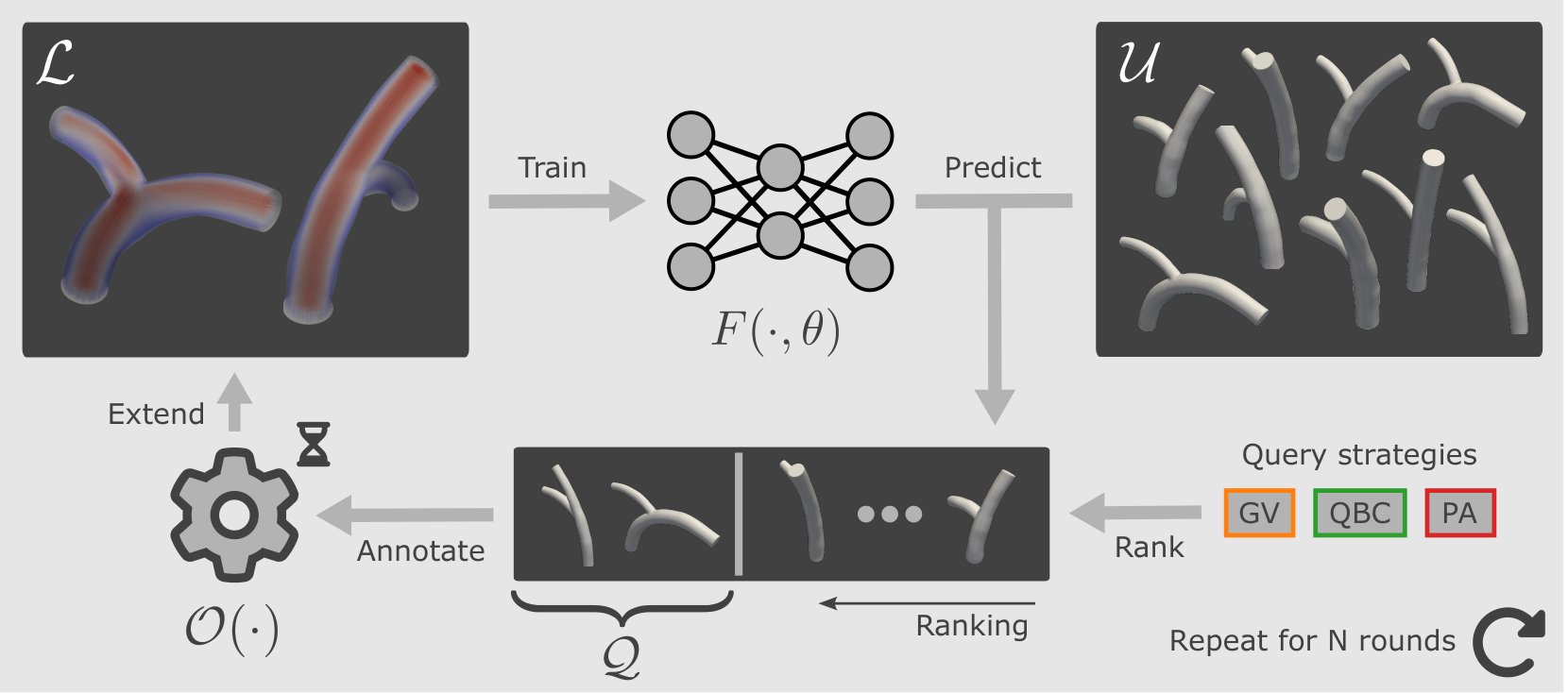
Choosing the next simulation
A fast neural surrogate still needs expensive simulations as training examples. This work introduces acquisition strategies based on geometry, ensemble uncertainty, and physical consistency to select informative examples before running CFD.
On synthetic coronary bifurcations, the strategies reduce the required training samples by up to 50% in the reported experiments, while improving robustness on difficult cases. This result concerns the evaluated benchmark rather than a universal reduction in simulation cost.
The work was presented at STACOM 2025; the proceedings were published in 2026.
Cite this work
@inproceedings{activelearning2026,
  title = {Active Learning for Deep Learning-Based Hemodynamic Parameter Estimation},
  author = { Patryk Rygiel and Julian Suk and Kak Khee Yeung and Christoph Brune and Jelmer M. Wolterink },
  year = {2026},
  booktitle = {Statistical Atlases and Computational Models of the Heart (STACOM)},
  pages = {108--118},
  doi = {10.1007/978-3-032-17734-6_11},
  eprint = {2503.03453},
  archivePrefix = {arXiv},
  url = { https://doi.org/10.1007/978-3-032-17734-6_11 }
}