Active Learning for Deep Learning-Based Hemodynamic Parameter Estimation
2025 conference · 2026 proceedings
Featured research · AB-GATr / 2026
arXiv · Preprint
Earlier title: Symmetry in the Wild: The Role of Equivariance in Neural Fluid Surrogates.
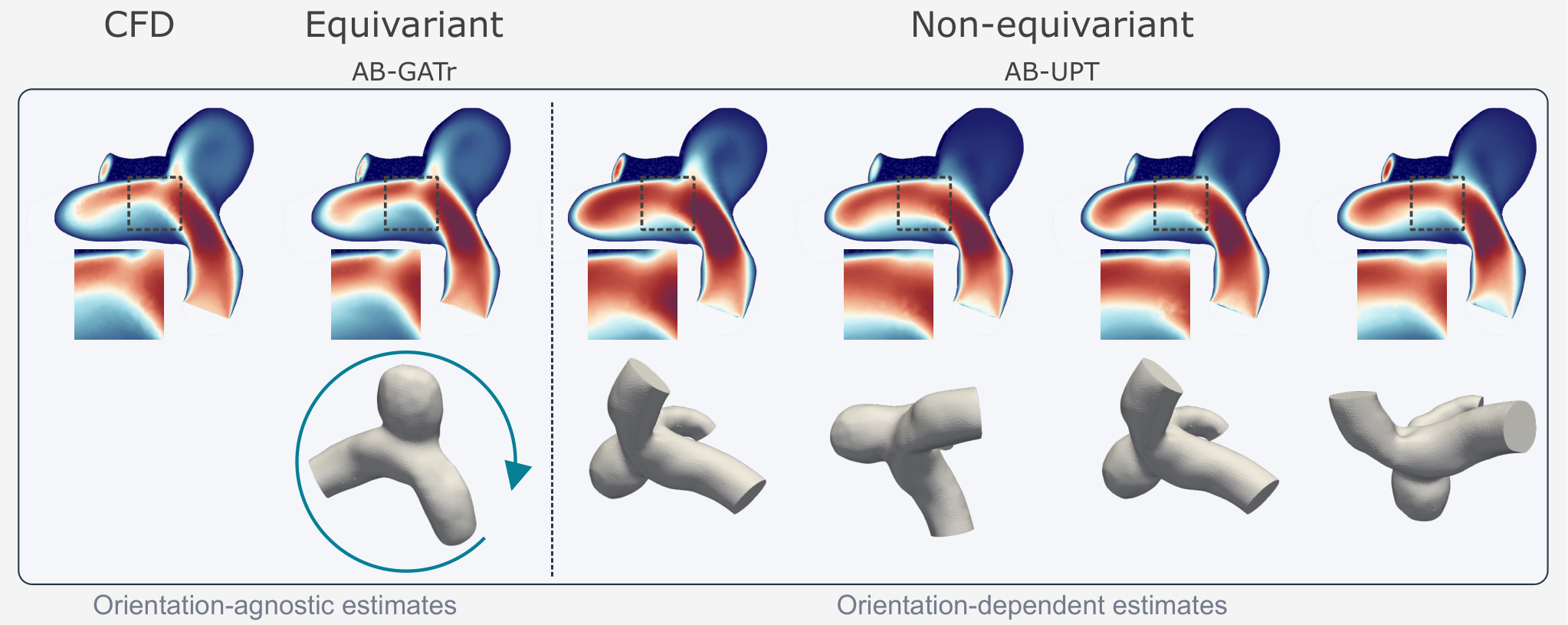
Can a model learn the physics of blood flow without relearning it for every orientation? AB-GATr explores how geometric symmetry and the way data is aligned affect neural fluid surrogates.
Interactive examples
Drag to rotate · Scroll or pinch to zoom · Right-drag to pan. With a view focused, use arrow keys to rotate, plus and minus to zoom, and R to reset.
Ground truth
Velocity magnitude cm/s
Prediction
Velocity magnitude cm/s
Slice relative L₂—
Volume relative L₂—
AB-GATr vs CFD
Error magnitude cm/s
CFD training data is costly, making physical symmetries useful priors for neural surrogates. The incompressible Navier–Stokes operator respects E(3) symmetry—translations, rotations, and reflections—when external forces are absent or transform consistently. Velocity vectors rotate or reflect with the domain; pressure values remain unchanged at corresponding points.
The solution map inherits this symmetry only when geometry, boundary conditions, and initial conditions transform together. Rotating a geometry while keeping its inflow direction fixed changes the physical problem.
In automotive aerodynamics, a wind-tunnel setup fixes the incoming flow direction, making relative orientation physically meaningful. Vascular flows often lack this external reference, although canonical alignment can still provide statistical cues. We study how these differences affect the value of equivariance in Sections 2.1–2.4 of the paper.
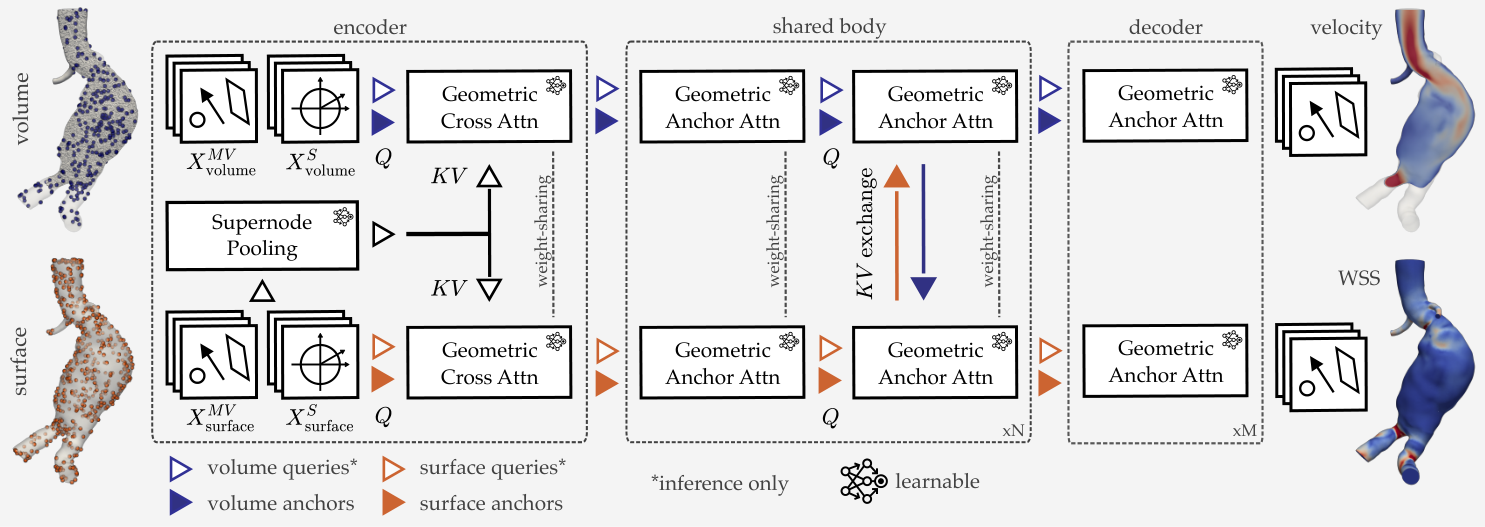
AB-GATr combines sparse geometric anchors with connected branches for surface and volume quantities. Its geometric algebra representation preserves E(3) equivariance while the branched architecture handles different prediction targets, such as velocity within a vessel and shear stress at its wall.
Explicit equivariance improves performance across the evaluated hemodynamic benchmarks.
A controlled automotive experiment shows that strong canonical alignment can favor non-equivariant models.
Rotational augmentation does not consistently reproduce the benefits of an equivariant architecture.
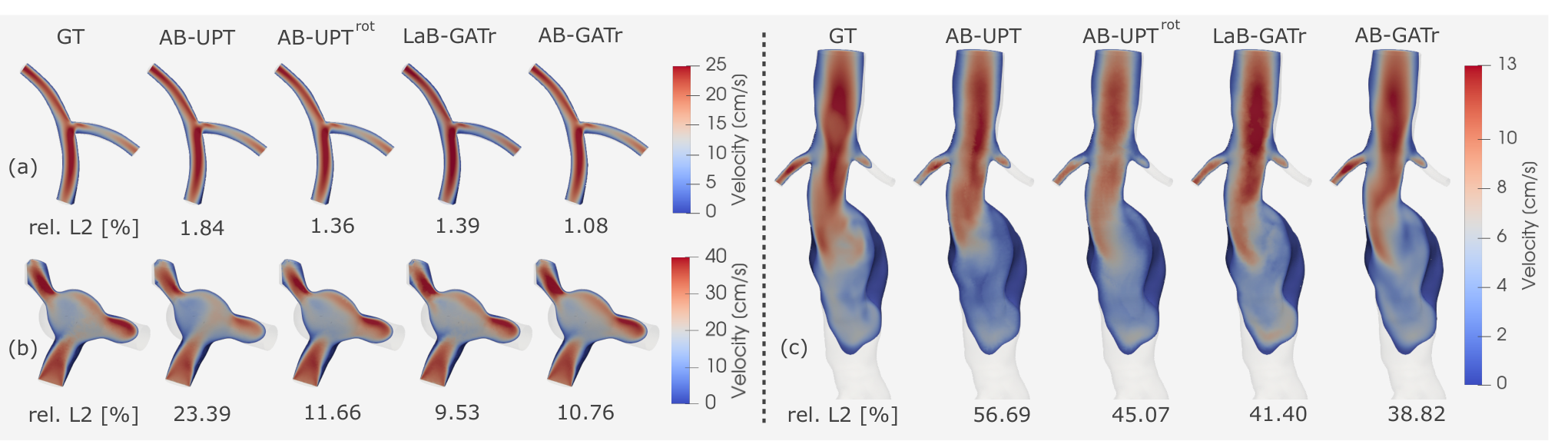
The conclusions depend on the evaluated tasks and orientation distributions. They do not establish that equivariance is universally beneficial. The paper reports the experiments and limitations in detail.
The official implementation contains the model and instructions for running the experiments. For the vascular geometry dataset, see AAA-100.
@misc{abgatr2026,
  title = {When Does Equivariance Help? Canonical Alignment in Neural Fluid Surrogates},
  author = { Patryk Rygiel and Julian Suk and Kak Khee Yeung and Christoph Brune and Jelmer M. Wolterink },
  year = {2026},
  doi = {10.48550/arXiv.2605.18816},
  eprint = {2605.18816},
  archivePrefix = {arXiv},
  url = { https://doi.org/10.48550/arXiv.2605.18816 }
}