Preprint / 2025
Wall Shear Stress Estimation in Abdominal Aortic Aneurysms: Towards Generalisable Neural Surrogate Models
arXiv · Preprint
Interactive examples
Generalisation challenges
CFD
Surface WSS vectors
LaB-GATr
Surface WSS vectors
Absolute error
Current-step relative L₂—
Overall relative L₂—
CFD
Surface WSS vectors
LaB-GATr
Surface WSS vectors
Absolute error
Current-step relative L₂—
Overall relative L₂—
This project dates from early 2025. Our newer AB-GATr work provides more accurate wall shear stress and velocity estimates.
Generalization beyond a fixed vessel model
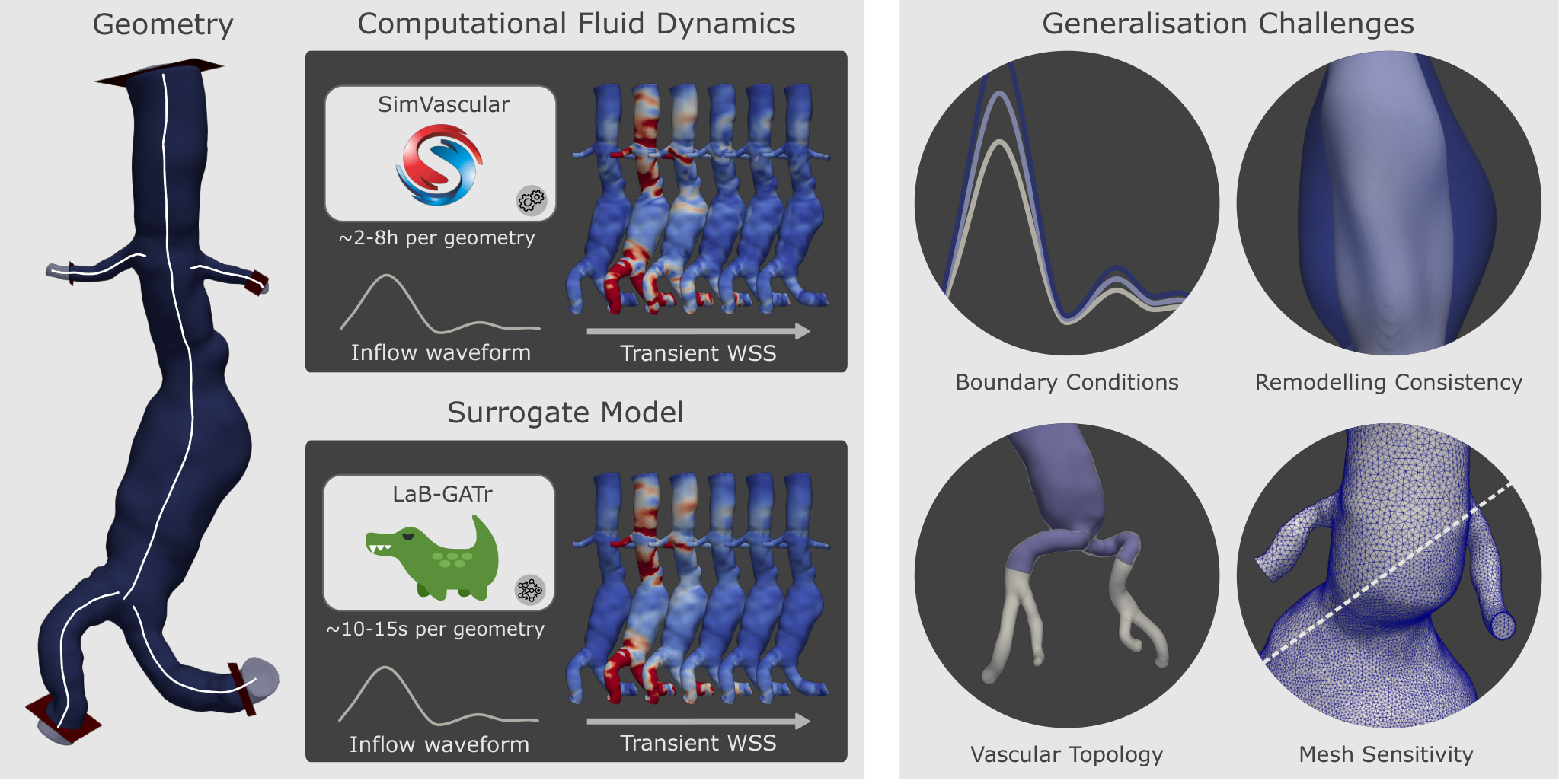
A useful surrogate must cope with the variation encountered in vascular modeling. This study uses geometric descriptors and projective geometric algebra to predict transient wall shear stress on abdominal aortic aneurysm surfaces.
The evaluation considers external cases, remodeled geometries, changing boundary conditions, new artery branches, and different mesh resolutions. These experiments test several distinct ways a model can encounter inputs that differ from its training data.
Cite this work
@misc{wallshearstressaaa2025,
  title = {Wall Shear Stress Estimation in Abdominal Aortic Aneurysms: Towards Generalisable Neural Surrogate Models},
  author = { Patryk Rygiel and Julian Suk and Christoph Brune and Kak Khee Yeung and Jelmer M. Wolterink },
  year = {2025},
  doi = {10.48550/arXiv.2507.22817},
  eprint = {2507.22817},
  archivePrefix = {arXiv},
  url = { https://doi.org/10.48550/arXiv.2507.22817 }
}