Journal article / 2025
Learning hemodynamic scalar fields on coronary artery meshes: A benchmark of geometric deep learning models
Computers in Biology and Medicine · Published
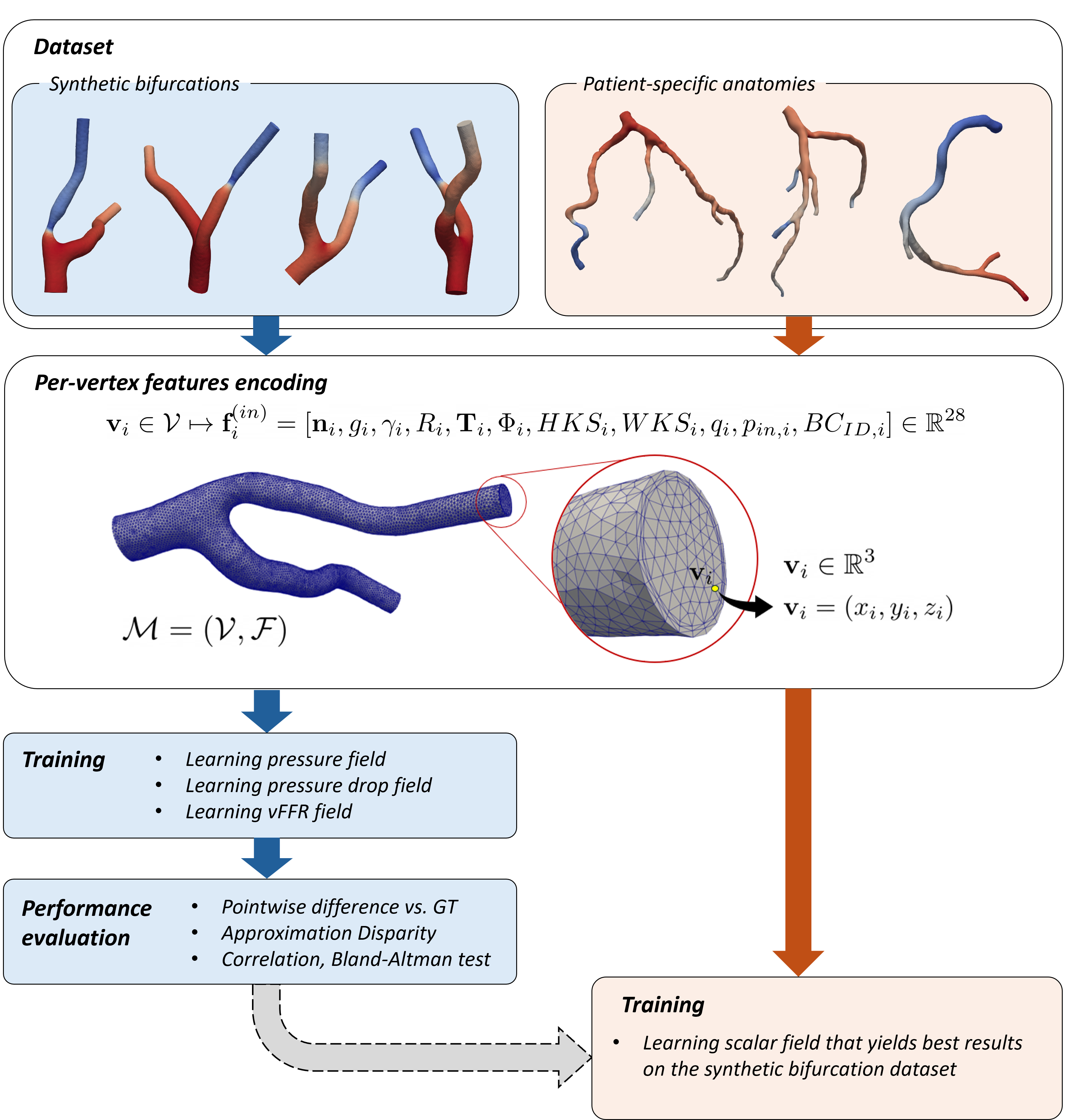
Comparing geometric models for coronary flow
The study compares multiple neural backends and prediction targets on synthetic and patient-specific coronary geometries. It examines how choices such as learning pressure drop rather than pressure influence the reconstruction of virtual fractional flow reserve.
The results distinguish performance on simple synthetic vessels from performance on more varied clinical geometries. This provides a practical basis for choosing architectures and learning targets for hemodynamic surrogate models.
Cite this work
@article{meshbenchmark2025,
  title = {Learning hemodynamic scalar fields on coronary artery meshes: A benchmark of geometric deep learning models},
  author = { Guido Nannini and Julian Suk and Patryk Rygiel and Simone Saitta and Luca Mariani and Riccardo Maranga and Andrea Baggiano and Gianluca Pontone and Jelmer M. Wolterink and Alberto Redaelli },
  year = {2025},
  journal = {Computers in Biology and Medicine},
  volume = {195},
  eid = {110477},
  doi = {10.1016/j.compbiomed.2025.110477},
  eprint = {2501.09046},
  archivePrefix = {arXiv},
  url = { https://doi.org/10.1016/j.compbiomed.2025.110477 }
}