Conference paper / 2026
GReAT: Leveraging Geometric Artery Data to Improve Wall Shear Stress Assessment
Shape in Medical Imaging (ShapeMI) · MICCAI 2025 workshop · Published · 2025 conference, 2026 proceedings
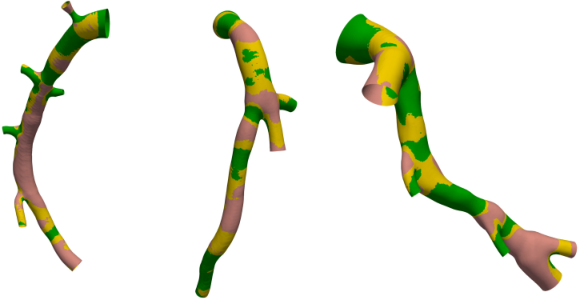
Learning from unlabeled artery geometry
Large collections of vascular shapes can provide useful training information even without matching flow simulations. GReAT uses heat-kernel signatures as a self-supervised learning target, then transfers the resulting geometric representation to coronary wall shear stress assessment.
The downstream task identifies regions with low, medium, or high time-averaged wall shear stress. The study examines whether geometric pretraining helps when only a small patient cohort is available.
Cite this work
@inproceedings{great2026,
  title = {GReAT: Leveraging Geometric Artery Data to Improve Wall Shear Stress Assessment},
  author = { Julian Suk and Jolanda J. Wentzel and Patryk Rygiel and Joost Daemen and Daniel Rueckert and Jelmer M. Wolterink },
  year = {2026},
  booktitle = {Shape in Medical Imaging (ShapeMI)},
  pages = {277--291},
  doi = {10.1007/978-3-032-06774-6_21},
  eprint = {2508.19030},
  archivePrefix = {arXiv},
  url = { https://doi.org/10.1007/978-3-032-06774-6_21 }
}