Journal article / 2025
Deep vectorised operators for pulsatile hemodynamics estimation in coronary arteries from a steady-state prior
Computer Methods and Programs in Biomedicine · Published
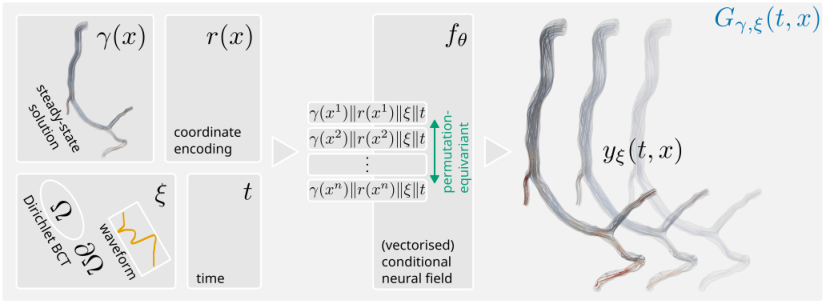
From steady flow to a pulse
This work introduces a neural operator formulation for estimating time-dependent velocity and pressure in coronary arteries. A neural field is conditioned on hemodynamic boundary conditions and uses a steady-state solution as prior information.
The formulation supports message-passing and attention mechanisms while retaining permutation equivariance. Experiments on patient-specific arteries examine both prediction accuracy and sensitivity to resampling the input domain.
Cite this work
@article{deepvectorised2025,
  title = {Deep vectorised operators for pulsatile hemodynamics estimation in coronary arteries from a steady-state prior},
  author = { Julian Suk and Guido Nannini and Patryk Rygiel and Christoph Brune and Gianluca Pontone and Alberto Redaelli and Jelmer M. Wolterink },
  year = {2025},
  journal = {Computer Methods and Programs in Biomedicine},
  volume = {271},
  eid = {108958},
  doi = {10.1016/j.cmpb.2025.108958},
  eprint = {2410.11920},
  archivePrefix = {arXiv},
  url = { https://doi.org/10.1016/j.cmpb.2025.108958 }
}