Conference paper / 2022
Coronary Ostia Localization Using Residual U-Net with Heatmap Matching and 3D DSNT
* Equal contribution
Machine Learning in Medical Imaging (MLMI) · MICCAI 2022 workshop · Published
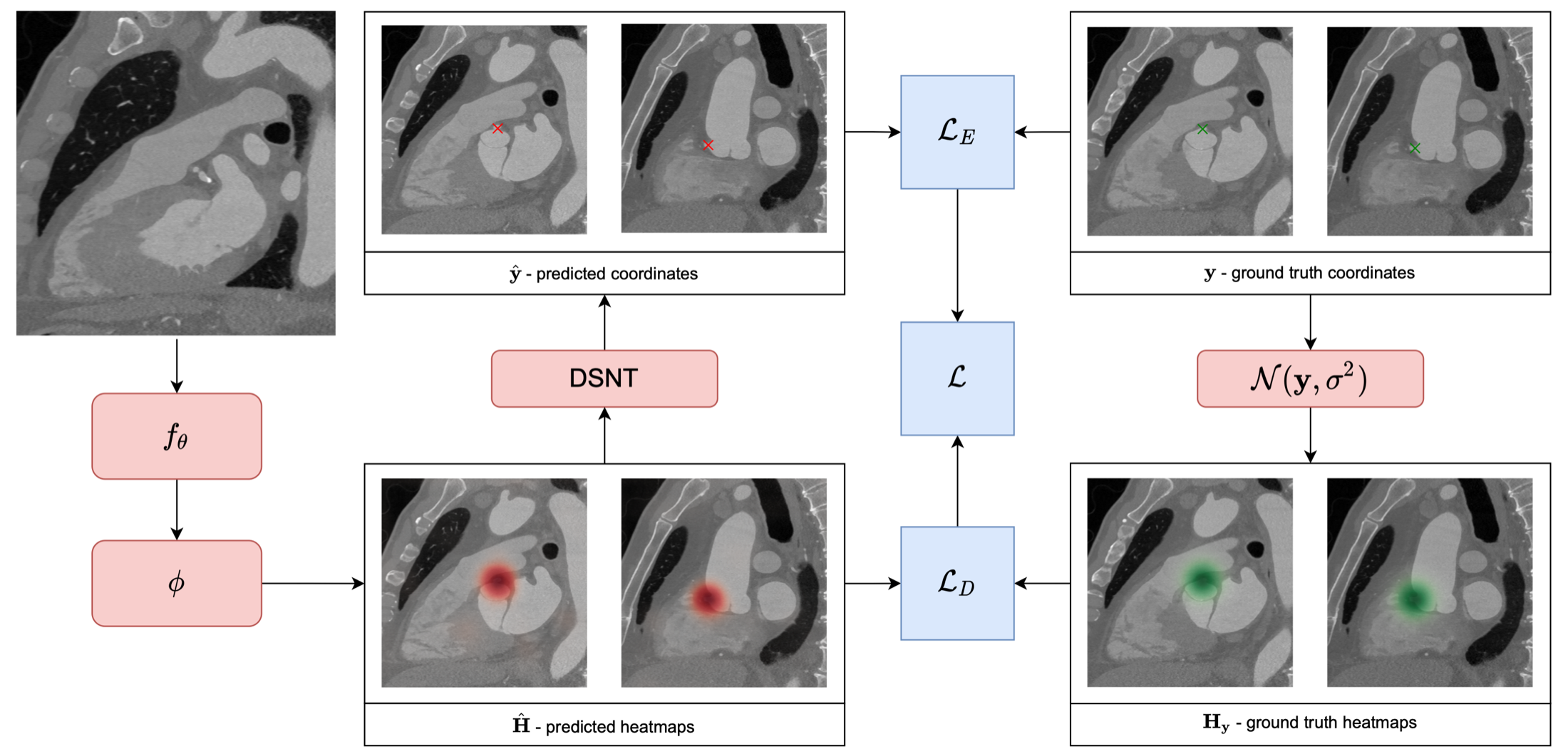
From an image volume to landmark coordinates
The method learns a heatmap for the coronary origins and converts that spatial distribution into coordinates with a differentiable spatial-to-numerical transform. This provides a single trainable pipeline for landmark localization.
The study evaluates localization on coronary and aortic CT angiography datasets. Miłosz Gajowczyk and Patryk Rygiel contributed equally.
Presented at the MLMI workshop held with MICCAI 2022 in Singapore.
Cite this work
@inproceedings{coronaryostia2022,
  title = {Coronary Ostia Localization Using Residual U-Net with Heatmap Matching and 3D DSNT},
  author = { Miłosz Gajowczyk and Patryk Rygiel and Piotr Gródek and Adrian Korbecki and Michał Sobański and Przemysław Podgórski and Tomasz Konopczyński },
  year = {2022},
  booktitle = {Machine Learning in Medical Imaging (MLMI)},
  pages = {318--327},
  doi = {10.1007/978-3-031-21014-3_33},
  url = { https://doi.org/10.1007/978-3-031-21014-3_33 }
}